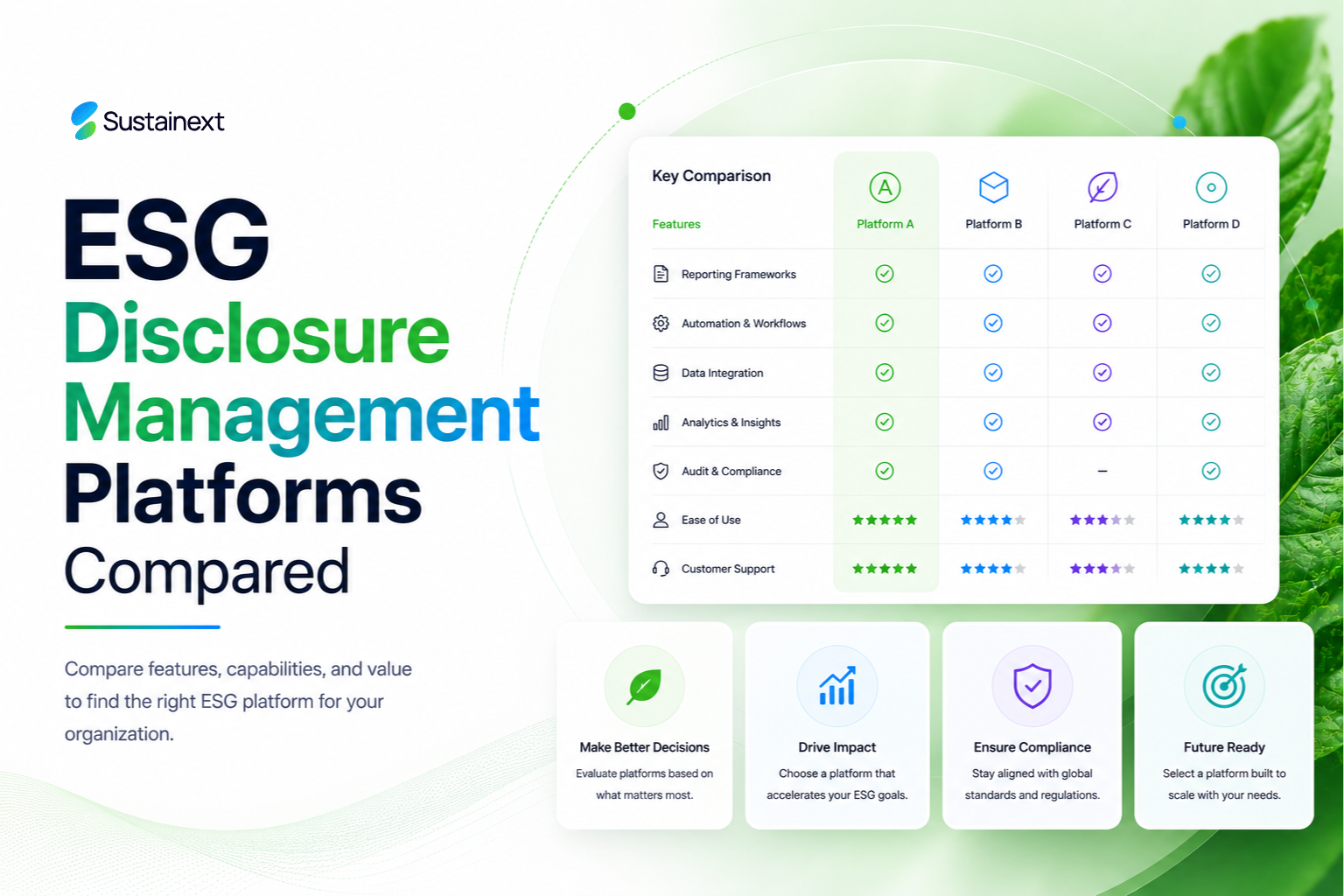
If your ESG team already knows spreadsheets are breaking down, the real buying question is no longer whether to adopt software. It is which ESG disclosure management platform can help you collect data faster, maintain internal controls, map evidence to multiple frameworks, and produce audit-ready outputs without turning implementation into a six-month side project.
That distinction matters. Many software roundups blur carbon accounting, ESG data management, and disclosure management into one category. But buyers under reporting pressure need a narrower lens. Finance-led and sustainability-led teams preparing investor-grade disclosures are typically less worried about generic dashboards and more worried about version control, approvals, evidence traceability, framework mapping, and assurance readiness.
This guide compares ESG disclosure management platforms specifically through that lens. Rather than asking which tool has the most features overall, we ask a more practical set of questions:
- How well does the platform support AI-powered ESG data collection?
- Can it map one dataset across frameworks like CSRD/ESRS, IFRS S1/S2, and GRI?
- Does it provide strong controls for reviews, approvals, and audit trails?
- Can suppliers and internal contributors submit evidence without creating chaos?
- How much rollout effort is required before teams see value?
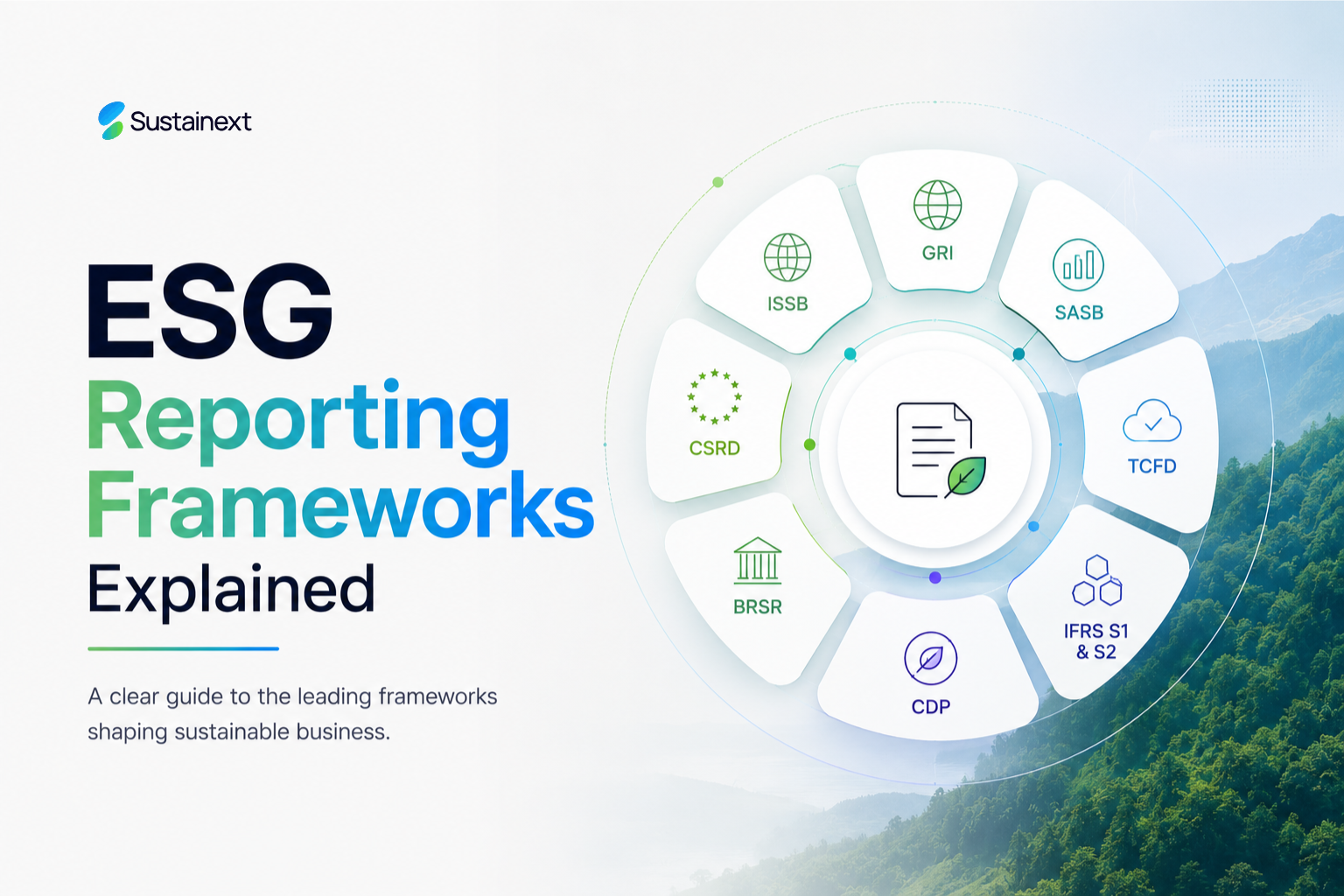
As disclosure obligations expand, reporting complexity is increasing too. In the EU, companies in scope of the Corporate Sustainability Reporting Directive must report under ESRS, with the first wave already applying the rules for financial year 2024 reports published in 2025. (finance.ec.europa.eu) Globally, the ISSB’s IFRS S1 and IFRS S2 have established a baseline for sustainability-related and climate-related financial disclosures, while GRI remains one of the most widely used sustainability reporting frameworks. (ifrs.org)
That is exactly why selecting the right platform has become a strategic decision, not just a procurement exercise.
What is an ESG disclosure management platform?
An ESG disclosure management platform is software designed to help companies coordinate the full reporting workflow behind sustainability and ESG disclosures. Unlike carbon-only tools, these platforms are built to handle document collection, metric validation, workflow approvals, framework mapping, and final disclosure outputs for investors, regulators, ratings agencies, and customers.
A strong platform usually combines:
- structured data capture from departments, sites, and suppliers
- evidence attachment and version history
- controls for review, sign-off, and change management
- disclosure mapping across frameworks and questionnaires
- reporting outputs suitable for assurance and board review
In practice, that means the best ESG disclosure management platforms reduce the painful parts of reporting: chasing inputs over email, reconciling different spreadsheet versions, copying the same narrative into multiple templates, and trying to prove where every number came from.
If your team also manages ratings and benchmark submissions, it helps to understand adjacent workflows such as eCOVADIS and GRESB, where evidence quality, structured responses, and repeatability matter just as much as the final score.
How we compared ESG disclosure management platforms
This is a commercial comparison for buyers in active evaluation mode. We weighted the categories around the needs of finance-led and compliance-conscious reporting teams.
Weighted evaluation criteria
| Criteria | Weight | Why it matters |
| AI-powered data collection | 20% | Reduces manual chasing and speeds up reporting cycles |
| Framework mapping and reusability | 20% | One source of truth should support multiple disclosures |
| Auditability and controls | 20% | Evidence traceability, approvals, and versioning are critical |
| Workflow and collaboration | 15% | Cross-functional reporting fails without contributor discipline |
| Supplier and third-party data collection | 10% | Scope 3, human rights, and value chain data depend on this |
| Implementation effort | 10% | Buyers need time-to-value, not another transformation project |
| Assurance readiness and export quality | 5% | Reports must stand up to internal and external scrutiny |
What buyers should watch for
Before you book demos, watch for these red flags:
- “AI” that only summarizes text rather than automating collection and mapping.
- Weak evidence controls, where numbers can be changed without a visible audit trail.
- Limited framework support, forcing your team to rebuild the same dataset for each disclosure.
- Poor contributor experience, which leads business units and suppliers back to email attachments.
- Implementation dependency on consultants, especially for every new framework or template.
ESG disclosure software comparison: what separates leaders from laggards
The biggest gap in the market is not between “basic” and “advanced” ESG software. It is between platforms built for disclosure operations and platforms built mainly for environmental data storage.
A modern disclosure platform should support:
- continuous evidence collection, not just annual uploads
- configurable workflows for owners, reviewers, and approvers
- reusable data objects that map to multiple questions and frameworks
- narrative and quantitative disclosure coordination in one place
- defensible exports for assurance, board packs, and filing prep
This matters because official reporting expectations are becoming more structured. CSRD reporting aligns to ESRS for in-scope entities, while IFRS S1 and S2 organize disclosures around governance, strategy, risk management, and metrics and targets. (finance.ec.europa.eu) GRI likewise provides a modular reporting system for economic, environmental, and social impacts. A platform that cannot normalize inputs and map them across these structures will create more work than it removes.
Comparison table: ESG disclosure management platforms in 2026
Below is a practical scoring model for shortlisting. The scores are directional rather than vendor-by-vendor rankings, because feature claims vary and enterprise fit depends on your reporting scope, existing systems, and governance maturity.
| Platform type | AI data collection | Framework mapping | Audit trail & controls | Supplier collaboration | Implementation effort | Best fit |
| AI-first disclosure platforms | 9/10 | 9/10 | 8/10 | 8/10 | 8/10 | Mid-market to enterprise teams with tight timelines |
| Enterprise ESG suites | 7/10 | 8/10 | 9/10 | 7/10 | 5/10 | Large enterprises with complex governance and IT support |
| Carbon-led platforms with reporting add-ons | 5/10 | 6/10 | 6/10 | 6/10 | 7/10 | Teams whose immediate priority is emissions accounting |
| Generic governance/document tools | 4/10 | 4/10 | 7/10 | 5/10 | 6/10 | Organizations patching disclosure workflows temporarily |
1. AI-first disclosure platforms
These are increasingly the best fit for companies that need to stand up structured reporting workflows quickly. Their advantage is not just automation for its own sake. It is the ability to reduce manual coordination across finance, sustainability, procurement, HR, legal, and operations.
The best products in this category can:
- request data from the right contributors automatically
- identify missing evidence or inconsistent entries
- map a single answer across multiple disclosure frameworks
- maintain a clear chain from source document to final disclosure
- accelerate annual refresh cycles after initial setup
For buyers searching phrases like best ESG disclosure management platforms or best ESG disclosure management platforms with AI-powered data collection, this category is often where the most immediate ROI appears.
2. Enterprise ESG suites
These platforms tend to score well on governance, permissions, and broad framework support. They can be a strong fit for large listed enterprises with formal internal control environments and multi-region reporting requirements.
But they often come with trade-offs:
- longer implementation cycles
- heavier admin overhead
- more consulting support
- slower adaptation when disclosure priorities shift quickly
If your organization has already standardized enterprise systems and has a mature PMO, that may be acceptable. If not, the complexity can delay value.
3. Carbon-led platforms with disclosure modules
These tools are often attractive because emissions reporting created the original business case. If your main need is Scope 1, 2, and 3 accounting, they may be a good starting point. But they can fall short when disclosure management expands into governance, workforce, supply chain, risk, policy, and narrative evidence.
This is where many teams discover that carbon accounting is only one input into the final report, not the reporting system itself.
4. Generic workflow or document tools
These include combinations of spreadsheets, shared drives, task managers, and document platforms held together by manual governance. They can work for one reporting cycle, particularly for smaller organizations or voluntary disclosures. But they rarely scale well under assurance pressure.
When people ask for an ESG reporting platform comparison, this category can look inexpensive at first. In reality, hidden costs show up as review bottlenecks, duplicated evidence requests, weak version control, and avoidable assurance findings.
The features that matter most in 2026
AI-powered ESG data collection
This should be your first filter. Real AI support means the platform helps teams collect, classify, validate, and route data, not just generate narrative drafts.
Look for capabilities such as:
- extracting structured data from uploaded evidence
- recommending framework mappings
- flagging incomplete or contradictory submissions
- assigning contributors automatically based on past cycles
- identifying when a prior-period datapoint has changed materially
That is what turns AI powered ESG data collection into operational leverage rather than marketing copy.
Framework mapping across CSRD, IFRS, and GRI
Many organizations now report to multiple stakeholders at once: regulators, investors, lenders, customers, benchmark providers, and ratings platforms. Since CSRD, ESRS, IFRS S1/S2, and GRI all require structured disclosures, reusable data architecture matters more than ever. (finance.ec.europa.eu)
A strong platform should let one approved datapoint and its evidence support multiple outputs. That cuts duplicate work and improves consistency.
Auditability, approvals, and version control
This is the line between a reporting tool and a disclosure management system. Every key metric and narrative should have:
- named owner
- reviewer and approver
- timestamped changes
- source evidence
- rationale for overrides or adjustments
If your assurance provider asks who changed a figure, when, and based on what evidence, the answer should be available instantly.
Supplier and third-party collaboration
For many companies, disclosure quality now depends on external contributors. Scope 3, supplier labor practices, water data, packaging claims, and due diligence evidence often sit outside the four walls of the company.
That is why supplier onboarding, guided questionnaires, reminders, and evidence collection are not “nice to have” features. They are core disclosure infrastructure.
Assurance readiness
Assurance readiness is not only about final report formatting. It is about whether the platform helps you prepare for testing before the assurance team arrives.
Look for:
- evidence completeness checks
- locked reporting periods
- exception logs
- structured review notes
- exportable audit trails
When to choose a specialist disclosure platform over a broad ESG suite
Choose a specialist disclosure platform when:
- you have a near-term reporting deadline
- you need faster rollout with lean internal teams
- finance and sustainability need one controlled workflow
- your biggest issue is collection and approvals, not just analytics
- you want faster multi-framework reuse
Choose a broad suite when:
- you need deep coverage across EHS, risk, carbon, supplier, and disclosure workflows in one stack
- IT can support longer implementation
- your governance requirements are very complex
- you are willing to trade speed for breadth
In other words, the answer depends less on company size alone and more on the maturity of your reporting operations.
How Sustainext should be evaluated in this category
For buyers comparing platforms today, Sustainext should be assessed as a disclosure-management-focused option rather than lumped into generic ESG software.
That means evaluating how it supports:
- structured disclosure workflows across teams
- reusable evidence and response libraries
- AI-assisted collection and mapping
- readiness for ratings, frameworks, and benchmarking submissions
- practical rollout without excessive configuration burden
For organizations handling both formal reporting and ratings responses, adjacent use cases like eCOVADIS and GRESB are useful signals. They reflect the same operational challenge: collect evidence once, govern it well, and reuse it across high-stakes disclosures. Teams exploring eCOVADIS workflows often face the same bottlenecks around evidence ownership and response quality as teams preparing investor-facing reports. Likewise, buyers involved in real assets or fund reporting can benefit from understanding how GRESB style submissions depend on structured, repeatable disclosure processes.
A practical shortlist framework for buying teams
If you are creating a shortlist, score each vendor against the following questions:
Data collection
- Can the platform collect quantitative and qualitative data?
- Can contributors submit evidence without extensive training?
- Does it reduce follow-up chasing?
Controls
- Are approvals configurable by disclosure, metric, or business unit?
- Is there a complete audit trail?
- Can prior-year values be locked or compared systematically?
Framework coverage
- Does the system support CSRD/ESRS, IFRS, GRI, and custom questionnaires?
- Can one datapoint map to multiple requirements?
- Are updates manageable without vendor intervention?
Rollout
- How long until the first reporting cycle goes live?
- How much internal admin is needed?
- What dependencies exist on consultants or implementation partners?
Output quality
- Can the platform support assurance reviews cleanly?
- Are exports usable for board, investor, and filing workflows?
- Does it strengthen confidence in final disclosures?
This gives you a more useful decision model than a simple feature checklist.
Final verdict: what matters most in an ESG reporting platform comparison
The best ESG disclosure management platforms in 2026 are not necessarily the ones with the broadest ESG feature lists. They are the ones that help reporting teams run a controlled, repeatable, multi-framework disclosure process with less manual effort and less risk.
That means your best-fit platform will usually be the one that does four things well:
- Automates data collection intelligently
- Maps information across frameworks without duplication
- Maintains strong evidence and approval controls
- Gets your team live fast enough to matter
If your immediate challenge is disclosure execution, do not let broad ESG marketing distract you from the workflow problem you actually need to solve. Use a disclosure-specific lens, score vendors against operational reality, and prioritize platforms that can produce investor-grade, audit-ready outputs without adding unnecessary complexity.
For teams that also manage recurring ratings and benchmark submissions, specialized workflows such as eCOVADIS and GRESB offer a useful parallel: better disclosure outcomes come from better collection systems, not from more spreadsheets.
FAQs
What are ESG disclosure management platforms?
ESG disclosure management platforms are software tools that help organizations collect, validate, approve, map, and publish sustainability disclosures. They are designed for structured reporting workflows rather than simple data storage.
What are the best ESG disclosure management platforms for finance-led reporting teams?
The best fit is usually a platform with strong audit trails, approval workflows, AI-powered collection, and multi-framework mapping. Finance-led teams should prioritize controls, evidence traceability, and assurance readiness over broad but shallow feature sets.
How should I evaluate an ESG disclosure software comparison?
Focus on six areas: AI-powered ESG data collection, framework coverage, auditability, contributor experience, supplier collaboration, and implementation effort. A good ESG disclosure software comparison should separate disclosure management from carbon accounting.
Do ESG compliance platforms also support CSRD, IFRS, and GRI?
Many do, but support depth varies significantly. Buyers should confirm whether the platform can map one approved datapoint across ESRS, IFRS S1/S2, and GRI instead of requiring duplicate workflows. Official guidance from the European Commission, IFRS Foundation, and GRI can help validate framework expectations. (finance.ec.europa.eu)
Why is AI powered ESG data collection important?
Because the largest reporting bottleneck is usually not drafting the final report. It is collecting complete, consistent, evidence-backed information from many contributors on time. AI can reduce manual coordination and improve data quality when applied to routing, extraction, mapping, and validation.