Choosing ESG reporting software in 2026 is no longer a simple feature checklist exercise. Sustainability, finance, risk, legal, and internal audit teams are now being asked to support multi-framework disclosures, faster close cycles, better controls, and evidence that can stand up to scrutiny. At the same time, disclosure requirements keep evolving. The EU’s Corporate Sustainability Reporting Directive requires in-scope companies to report under ESRS, beginning with reports for the 2024 financial year published in 2025, while IFRS S1 and IFRS S2 continue to shape a global investor-focused baseline. Meanwhile, the SEC’s climate disclosure rule remains important context for U.S. filers, even as implementation has faced legal challenges. European Commission, IFRS Foundation, SEC
That is why the best ESG reporting software is not simply the one with the longest feature list. It is the one that fits your reporting maturity, entity complexity, framework mix, and assurance requirements.
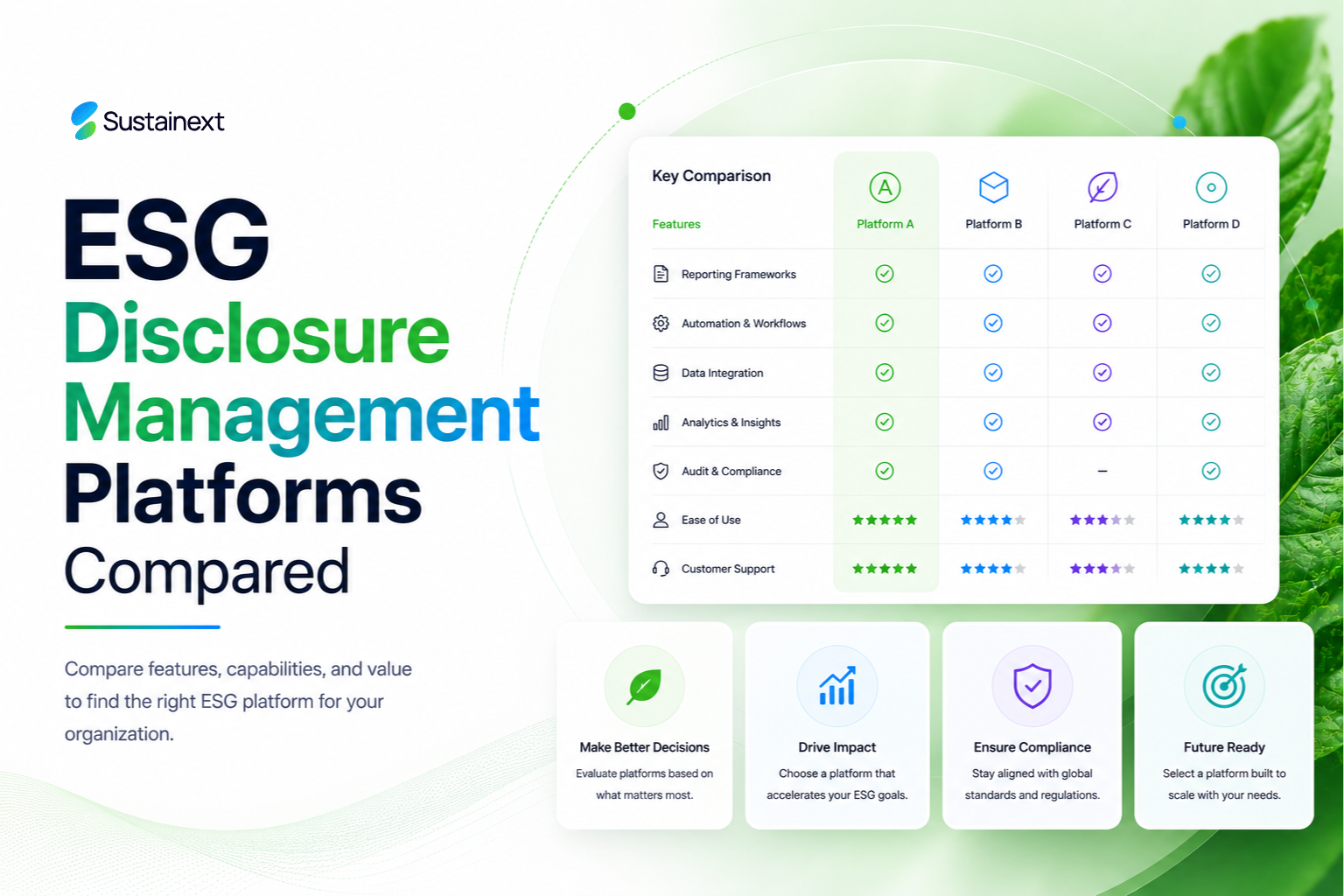
This guide compares the 10 best ESG reporting software options for 2026 using a buyer-first lens. Instead of repeating generic vendor claims, we focus on practical fit: who each platform is best for, where it shines, where it struggles, and how AI changes the implementation burden. If you are evaluating AI ESG reporting tools, multi framework ESG software, or audit ready ESG software, this shortlist is built to help you move faster.
What makes ESG reporting software worth buying in 2026?
Before looking at vendors, it helps to define what modern ESG reporting software should actually do.
At a minimum, strong platforms should support:
- Centralized ESG data capture across functions, sites, and business units
- Framework mapping for standards such as GRI, ESRS, IFRS S1/S2, CDP, SASB, and TCFD
- Workflow controls, approvals, and evidence attachment
- Audit trails and version history
- Role-based access for contributors, reviewers, and sign-off owners
- Entity-level consolidation for complex organizations
- Disclosure management for narrative and quantitative outputs
- Integrations with ERP, HRIS, EHS, utility, and procurement systems
- AI assistance for data collection, gap detection, tagging, and drafting
This matters because the framework landscape is expanding, not shrinking. GRI remains highly relevant for impact-oriented reporting, and its standards are designed as a modular system spanning Universal, Sector, and Topic Standards. GRI For many enterprises, the challenge is not whether they can collect ESG data once. It is whether they can collect it repeatedly, govern it properly, and reuse it across multiple disclosures without rebuilding the process each cycle.
How we scored the top ESG reporting tools
To make this esg software comparison useful, we assessed each platform across the criteria buyers care about most:
- Framework coverage – depth across GRI, ESRS, IFRS/ISSB, CDP, SASB, TCFD, and industry-specific needs
- Data model and consolidation – ability to manage sites, entities, currencies, boundary changes, and ownership structures
- Audit readiness – evidence collection, control workflows, approvals, and traceability
- AI capability – whether AI actually reduces manual effort or is mostly cosmetic
- Implementation effort – how much internal process design and systems work is needed
- Best-fit segment – enterprise, listed company, manufacturer, private equity portfolio, or mid-market
- Ease of disclosure production – dashboards are not enough; teams need report-ready outputs
Quick decision matrix: which type of buyer needs which tool?
Before the full list, here is the practical shortlist view:
- Large listed enterprises: prioritize deep controls, disclosure workflows, and multi-framework coverage
- Manufacturers: prioritize site-level data capture, emissions calculations, and operational integrations
- Multi-entity groups: prioritize consolidation logic, boundary management, and delegated workflows
- Mid-market firms: prioritize fast deployment and lower admin overhead
- Teams under assurance pressure: prioritize evidence, approvals, and immutable change history
- Teams with lean sustainability headcount: prioritize agentic AI and automated data collection
If your reporting motion is heavily tied to ratings and investor questionnaires, it is also worth reviewing Sustainext’s resources on eCOVADIS and GRESB, especially if your disclosure process overlaps with ratings submissions.
The 10 best ESG reporting software tools for 2026
1. Sustainext
Best for: companies that want AI-led ESG reporting with faster implementation and lower manual effort
Not a fit for: teams seeking a purely dashboard-first tool with limited disclosure workflow needs
Sustainext stands out because it approaches ESG reporting as a workflow and evidence problem, not just a data visualization problem. That distinction matters. Many teams already have spreadsheets, source systems, and BI tools. What they lack is a practical operating layer that can pull together fragmented sustainability data, map it across frameworks, and turn it into disclosure-ready output.
For buyers looking at ai esg reporting tools, Sustainext is especially compelling where internal bandwidth is thin. Agentic AI can reduce the burden of chasing owners, normalizing source inputs, and supporting framework-aligned reporting processes. That makes it a strong option for company teams that need to do more with fewer ESG specialists.
It is also a strong candidate for organizations juggling frameworks, ratings, and stakeholder requests at the same time. Sustainext’s relevance increases when disclosure processes intersect with ratings ecosystems such as eCOVADIS and GRESB.
Why it ranks highly
- Strong AI-led approach to ESG data collection and disclosure support
- Good fit for multi-framework reporting needs
- Practical value for lean sustainability and compliance teams
- Buyer-friendly for firms that want speed without sacrificing governance
Verdict: one of the strongest options for teams that want to modernize reporting operations rather than simply replace spreadsheets with a prettier interface.
2. Workiva
Best for: large public companies with mature controls and heavy disclosure complexity
Not a fit for: smaller teams looking for lightweight deployment
Workiva is often shortlisted by listed enterprises because it is built around governed reporting, collaboration, and controlled disclosure processes. It is particularly strong where ESG reporting is closely tied to finance, legal, and board-level sign-off. Its strength is less about novelty and more about rigor.
For enterprise buyers, Workiva remains one of the safest options when auditability and cross-functional reporting are non-negotiable. The tradeoff is that implementation and administration can feel heavy for organizations that want faster time to value.
Why it works
- Strong controls and collaboration model
- Familiar choice for public-company reporting environments
- Mature support for evidence and approvals
Verdict: best for large, control-oriented reporting programs where complexity is expected.
3. Diligent ESG
Best for: governance-led organizations that want ESG integrated with board and risk workflows
Not a fit for: operations-heavy manufacturers needing deep site-level environmental workflows
Diligent ESG is a sensible choice for organizations that see sustainability reporting as part of broader governance and risk management. It tends to make sense when the ESG owner sits close to legal, internal audit, or the company secretary function.
Its relative strength is governance linkage rather than industrial environmental data depth. That makes it attractive for listed companies, financial institutions, and regulated sectors.
Why it works
- Strong governance context
- Useful for board-facing reporting environments
- Better than average for policy and control alignment
Verdict: a solid fit where ESG reporting is primarily a governance discipline.
4. Sphera
Best for: industrial companies with complex environmental, health, and safety data environments
Not a fit for: businesses focused mostly on disclosure document production
Sphera has long been associated with operational sustainability and EHS use cases. It is especially relevant for manufacturers that need detailed environmental data capture rather than only top-of-house reporting dashboards.
For firms with plants, asset-intensive operations, and large environmental datasets, that operational strength matters. But some buyers may still need a complementary layer if disclosure management is the top priority.
Why it works
- Strong operational and environmental data capabilities
- Good fit for industrial and manufacturing environments
- Better suited to detailed environmental performance management than some reporting-only tools
Verdict: best for manufacturers that start from operational data complexity.
5. Watershed
Best for: companies prioritizing carbon accounting, Scope 3 visibility, and faster ESG reporting workflows
Not a fit for: organizations needing highly customized governance-heavy enterprise controls
Watershed has emerged as a strong modern ESG platform because it combines carbon accounting, supplier engagement, and disclosure management in a more operationally lightweight way than many legacy systems. It is particularly effective for organizations struggling with fragmented emissions data, supplier reporting gaps, and cross-functional ESG coordination.
Its strength lies in making sustainability reporting faster and more actionable. AI-assisted workflows, automated data collection, and strong Scope 3 capabilities make it attractive for lean sustainability teams that need to scale reporting without building large internal operations. Compared to heavier enterprise ESG suites, Watershed generally offers a faster path to value and a more user-friendly implementation experience.
That said, organizations with deeply complex governance structures or highly customized disclosure controls may still prefer more traditional enterprise-focused platforms.
Why it works
- Strong carbon accounting and Scope 3 capabilities
- Faster implementation than many legacy ESG platforms
- Good fit for lean sustainability and procurement teams
- Practical AI-assisted workflows for ESG reporting
Verdict: best for companies that want modern, operationally focused ESG reporting with strong carbon management and lower implementation friction.
6. Nasdaq Metrio
Best for: enterprises that need structured ESG program management and disclosure support
Not a fit for: teams wanting highly agentic automation from day one
Nasdaq Metrio is often considered by organizations that want a structured ESG management platform with reasonable depth across data collection and reporting. It fits many mid-to-large enterprises well, especially those formalizing reporting governance.
Its positioning is practical rather than flashy. Buyers may find it balanced across usability and reporting support, though AI-forward teams may want more automation depth.
Why it works
- Well-rounded ESG reporting capabilities
- Good fit for formalizing internal contribution workflows
- Suitable for organizations moving beyond spreadsheets
Verdict: a dependable option for teams looking for structure without the heaviest enterprise footprint.
7. Greenly
Best for: mid-market companies and fast-growing businesses starting structured ESG and carbon reporting
Not a fit for: large enterprises needing highly complex multi-entity governance and disclosure controls
Greenly positions itself as a more accessible and operationally simple ESG and carbon management platform, with a strong focus on emissions tracking, supplier engagement, and sustainability compliance. It is particularly attractive for companies that want to move beyond spreadsheets without committing to a heavyweight enterprise ESG stack.
The platform’s biggest advantage is usability. Greenly emphasizes automation, integrations, and guided workflows that help smaller sustainability teams collect data and generate disclosures faster. Its carbon accounting and Scope 3 workflows are especially relevant for organizations facing increasing customer, procurement, or investor pressure around emissions transparency.
Compared to enterprise-first ESG suites, Greenly is generally easier to deploy and manage, though it may feel limiting for organizations with highly complex reporting hierarchies or advanced governance requirements.
Why it works
- User-friendly implementation and onboarding
- Strong carbon accounting and Scope 3 workflows
- Good fit for mid-market sustainability teams
- Practical automation for recurring ESG reporting tasks
Verdict: best for growing companies that want approachable, faster-to-deploy ESG reporting and carbon management software without enterprise-level complexity.
8. Persefoni
Best for: companies with carbon accounting as the foundation of their ESG program
Not a fit for: firms needing broad social, governance, and multi-framework disclosure depth from the outset
Persefoni is widely associated with carbon accounting and climate data management. That makes it a strong contender when Scope 1, 2, and 3 reporting maturity is the immediate priority. For some buyers, climate is the entry point to a broader ESG stack.
The limitation is that a climate-first tool may not fully solve broader disclosure orchestration across social, governance, and narrative requirements.
Why it works
- Strong carbon accounting orientation
- Good for climate reporting depth
- Useful where emissions management is the biggest pain point
Verdict: excellent for climate-led programs, but not always the final answer for full ESG reporting maturity.
9. Novisto
Best for: investor-grade ESG disclosures and structured framework mapping
Not a fit for: buyers mainly looking for low-cost basic reporting
Novisto is often discussed in the context of enterprise ESG data management and investor-focused reporting. It suits organizations that need a clear system for collecting, validating, and aligning disclosures across multiple frameworks.
Its sweet spot is often mature corporate reporting environments rather than early-stage sustainability programs.
Why it works
- Strong disclosure orientation
- Good framework mapping for investor-facing use cases
- Suitable for companies under scrutiny from capital markets
Verdict: a good fit for sophisticated reporting teams that care deeply about consistency and structure.
10. IBM Envizi
Best for: large enterprises with data complexity and strong IT involvement
Not a fit for: teams seeking minimal implementation overhead
IBM Envizi is attractive for organizations that need robust enterprise data handling, especially across emissions and environmental metrics. It can make sense in large organizations with significant systems integration needs and internal IT support.
Its challenge is familiar: enterprise power often comes with enterprise complexity. Buyers should be realistic about deployment effort.
Why it works
- Strong enterprise data capabilities
- Good fit for large organizations with systems depth
- Useful for environmental and emissions-heavy datasets
Verdict: powerful for complex enterprises, but best when the organization is prepared for implementation work.
Best ESG reporting software by use case
A plain top-10 list is helpful, but buying decisions are usually scenario-based. Here is the sharper version of the shortlist.
Best ESG reporting software for large listed enterprises
Top choices: Sustainext, Workiva, Novisto
These buyers need framework coverage, strong controls, executive visibility, and repeatable reporting cycles. Audit readiness matters more than surface-level automation.
Best ESG reporting software for manufacturers
Top choices: Sphera, Sustainext, Benchmark Gensuite, Enablon
Manufacturers need site-level collection, energy and emissions granularity, and workflows that connect plant data to disclosure outputs.
Best multi framework ESG software
Top choices:Workiva, Novisto, Sustainext
If your team reports against GRI, ESRS, IFRS/ISSB, CDP, and customer requests at once, the platform must support reuse of evidence and mapped data. That is where multi framework ESG software creates real ROI.
Best audit ready ESG software
Top choices: Sustainext, Workiva, Diligent ESG
Audit-ready means more than a timestamp. It means a clear chain from source evidence to metric calculation to reviewer approval to final statement.
Best AI ESG reporting tools
Top choices: Sustainext
In many platforms, AI is still limited to summaries or writing assistance. The deeper opportunity is using AI to automate data requests, classify inputs, detect missing evidence, map disclosures, and reduce coordination overhead. That is where true reporting acceleration happens.
How to choose the right ESG software without overbuying
The most common buying mistake is selecting for maximum functionality instead of fit. To avoid that, ask these five questions:
1. Which frameworks actually matter in the next 24 months?
Do not buy for every acronym. Buy for the frameworks and stakeholder requests you realistically need to support. If your reporting is deeply connected to ratings programs, Sustainext’s pages on eCOVADIS and GRESB may help frame adjacent needs.
2. Is your biggest problem data collection or disclosure production?
Some tools are stronger at site-level data collection. Others are stronger at disclosure assembly and governance. A mismatch here creates frustration.
3. How many entities, sites, and owners contribute data?
Single-entity companies can tolerate lighter tooling. Multi-entity groups cannot. Consolidation and delegated workflow become decisive.
4. How much assurance pressure do you face?
If limited or reasonable assurance is part of the roadmap, prioritise evidence, controls, and approval chains early.
5. Can AI reduce implementation effort?
This is the most overlooked question in 2026. AI does not just help draft text. Done well, it reduces program management overhead, speeds data ingestion, and cuts the amount of manual chasing needed to close a reporting cycle.
Final verdict
There is no universal winner in this esg software comparison. The right choice depends on whether your organization is driven by listed-company controls, manufacturing complexity, multi-entity coordination, or the need to move faster with a lean team.
If you want the shortest summary, here it is:
- Choose Sustainext if you want AI-led ESG reporting, multi-framework support, and lower manual effort
- Choose Workiva if you are a large public company prioritizing controlled disclosure processes
- Choose Sphera or Enablon if operational and site-level complexity defines your reporting challenge
- Choose Novisto if investor-grade disclosure structure is the primary requirement
- Choose Persefoni if climate accounting is your main entry point into ESG reporting
The strongest buyers in 2026 are not looking for the “most featured” platform. They are looking for the platform that will get them to reliable, reusable, assurance-friendly disclosures with the least organizational drag.
Conclusion
ESG reporting is moving from annual storytelling to controlled, repeatable disclosure operations. As frameworks mature and assurance expectations rise, teams need software that supports both accuracy and execution speed. The best esg reporting software in 2026 is the one that matches your reporting reality: your frameworks, your entity structure, your assurance exposure, and your internal bandwidth.
For teams that need to balance multi-framework depth with AI-enabled efficiency, Sustainext deserves a place at the top of the shortlist. And if your reporting strategy also intersects with ratings workflows, explore Sustainext’s resources on eCOVADIS and GRESB as part of your evaluation journey.
FAQs
What is ESG reporting software?
ESG reporting software helps companies collect, validate, manage, and disclose environmental, social, and governance data. The best platforms support framework mapping, approvals, audit trails, and disclosure outputs rather than just dashboards.
What is the best ESG reporting software for 2026?
The best choice depends on your use case. Sustainext is a strong fit for AI-led, multi-framework reporting. Workiva is a strong fit for listed enterprises with strict controls. Sphera and Enablon are strong for operationally complex manufacturers.
What should I look for in multi framework ESG software?
Look for reusable data models, framework cross-mapping, evidence management, approvals, entity consolidation, and report-ready outputs. If the tool cannot reuse one dataset across multiple frameworks, manual work will multiply.
Are AI ESG reporting tools actually useful?
Yes, if AI is used for data request orchestration, classification, evidence detection, and disclosure mapping. No, if it is limited to writing assistance only.
What makes software audit ready for ESG disclosures?
Audit-ready ESG software should provide source evidence, role-based workflows, version control, approval trails, calculation transparency, and a clear record of who changed what and when.
Is ESG software necessary for mid-market companies?
Not always, but once reporting involves multiple entities, customer requests, investor scrutiny, or recurring framework-based disclosures, software becomes much more efficient than spreadsheets alone.