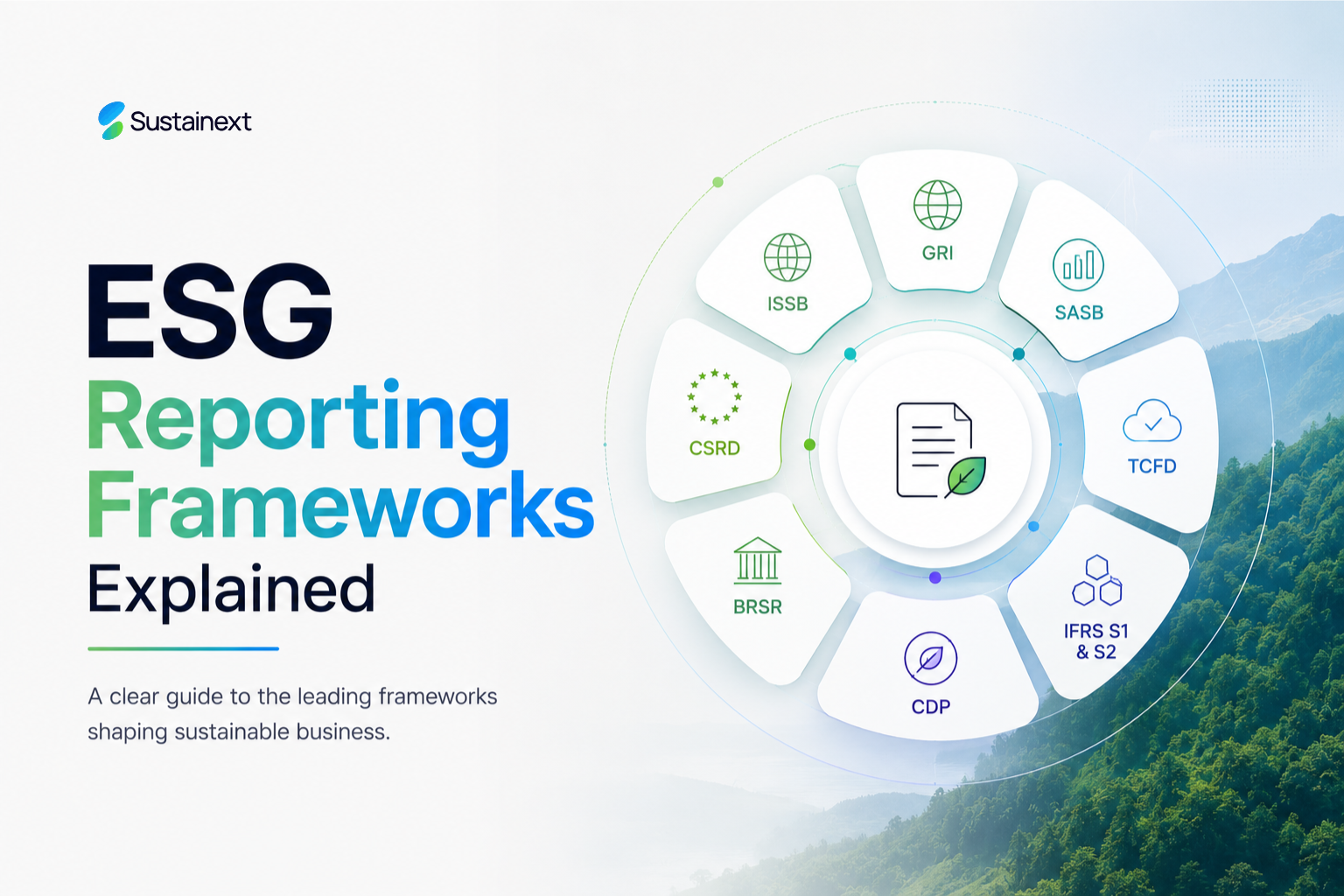
Many sustainability teams still use framework, standard, questionnaire, and regulation as if they mean the same thing. They do not. That confusion creates duplicated work, inconsistent evidence, and last-minute reporting stress.
If your team is trying to understand ESG reporting frameworks in 2026, the simplest way to think about them is this:
- some frameworks help you decide what impacts to report
- some standards define what investors want disclosed
- some rules determine what you must publish by law
- some systems collect information through structured questionnaires
- and the most efficient reporting programs use one underlying data model to serve all of them
That last point matters most. In practice, companies rarely report against just one framework anymore. A single organization may need to support GRI for broad sustainability impact reporting, ISSB for investor-focused disclosures, ESRS for EU-regulated reporting, and CDP for environmental questionnaires. The winning approach is not to build four separate reporting processes. It is to map one reusable dataset across multiple disclosure outputs.
This guide explains the major sustainability reporting frameworks in plain English, clarifies GRI vs ISSB vs ESRS, and shows how to choose the right mix for your business in 2026.
Why ESG reporting frameworks are so confusing
The market developed in layers. Voluntary sustainability reporting came first. Investor-led disclosure expectations followed. Then jurisdictional rules arrived. As a result, many organizations now operate inside a mixed environment of:
- voluntary frameworks
- capital-markets standards
- region-specific legal obligations
- stakeholder questionnaires
- ratings and assessments
The terminology overlap is part of the problem:
- Frameworks provide structure for how to think about sustainability disclosures.
- Standards contain more specific disclosure requirements.
- Regulations determine mandatory reporting obligations.
- Questionnaires and assessments collect responses in a fixed format for customers, investors, or ratings bodies.
For example, the GRI Standards are designed to help organizations report their impacts on the economy, environment, and people. GRI describes them as global standards for sustainability impacts. (globalreporting.org) By contrast, the ISSB standards focus on sustainability-related risks and opportunities that affect enterprise value, with IFRS S1 and IFRS S2 built around governance, strategy, risk management, and metrics and targets. (ifrs.org) The ESRS sit inside the EU’s corporate sustainability reporting regime and are tied to the CSRD disclosure architecture. (finance.ec.europa.eu) And CDP uses disclosure questionnaires covering climate change, water security, and forests. (cdp.net)
So when people ask for esg frameworks explained, what they usually need is not another glossary. They need a practical framework map.
The five ESG reporting systems most teams need to understand
1. GRI: best for impact-based reporting
GRI remains one of the most recognized global sustainability reporting systems. GRI states that its standards enable organizations to understand and report their impacts on the economy, environment, and people, and describes its reporting system as the world’s most widely used. (globalreporting.org)
Use GRI when your organization wants to answer questions such as:
- What impacts do we have on people and planet?
- Which sustainability topics are material from a stakeholder perspective?
- How do we structure a broad sustainability report beyond climate alone?
GRI is especially useful when you need a comprehensive narrative across environmental, social, and governance topics instead of a narrow investor lens.
For companies also dealing with ratings or customer-led ESG requests, GRI can play a foundational role because it encourages stronger impact-topic coverage across the value chain.
If your reporting program already supports multiple frameworks, it often helps to connect GRI-aligned disclosures with broader sustainability workflows such as eCOVADIS and sector or investor-facing programs like GRESB.
2. ISSB: best for investor-focused sustainability disclosure
The International Sustainability Standards Board created IFRS S1 and IFRS S2 to establish a global baseline for sustainability-related financial disclosures. IFRS says IFRS S1 covers general sustainability-related financial disclosures, while IFRS S2 sets specific climate-related disclosure requirements and fully integrates the TCFD recommendations. (ifrs.org)
ISSB is the right lens when the core question is:
- What sustainability issues could reasonably affect enterprise value?
- What do capital markets need in a decision-useful disclosure?
- How do we organize climate and sustainability information with financial-reporting discipline?
For listed companies, multinational groups, and firms preparing for more investor scrutiny, ISSB is increasingly important because it translates sustainability topics into disclosure logic that finance teams understand.
This is also where software matters. A strong ESG reporting platform should not treat ISSB as a standalone report-writing exercise. It should link evidence, controls, metrics ownership, and audit trails back to the same core dataset used elsewhere.
3. ESRS: best for CSRD-aligned EU reporting
The European Sustainability Reporting Standards (ESRS) are the reporting standards used under the EU corporate sustainability reporting regime. The European Commission’s corporate sustainability reporting materials and EFRAG’s ESRS resources confirm that the first set of ESRS has been adopted and sits within the broader CSRD implementation framework. (finance.ec.europa.eu)
ESRS is different from many voluntary systems because it is deeply tied to legal reporting obligations for in-scope entities. It also introduces a more operationally demanding concept: double materiality.
That means companies must assess:
- financial materiality: how sustainability matters affect the business
- impact materiality: how the business affects people and the environment
This is where many teams underestimate the workload. Double materiality changes not just the report output, but the whole process for scoping topics, gathering evidence, and involving stakeholders.
In practical terms, ESRS tends to require:
- broader topic coverage
- clearer methodology documentation
- traceable decisions on material matters
- stronger linkage between policies, actions, targets, and metrics
- tighter governance across legal, sustainability, risk, and finance teams
If your company operates across real estate or funds, related disclosure efforts may also intersect with GRESB, while supplier and procurement expectations may connect with eCOVADIS.
4. CDP: best for structured environmental disclosure
CDP is not the same as GRI, ISSB, or ESRS. It is a disclosure system built around structured questionnaires. CDP states that its question bank covers climate change, water security, and forests, and reports that more than 23,100 organizations responded to market demand for disclosure data in the prior year’s disclosure cycle. (cdp.net)
CDP is especially relevant when:
- customers request environmental disclosure
- procurement teams require climate and supply-chain transparency
- your organization wants a disciplined annual environmental data process
- you need to reuse climate, water, and forests data across stakeholders
The important insight is that CDP often draws from information that already exists for other disclosures. Emissions inventories, risk descriptions, governance structures, targets, transition actions, water dependencies, and supplier engagement data should not live in separate silos.
5. Jurisdictional rules: best understood as mandatory overlays
In 2026, many companies face a mix of national or regional rules layered onto broader reporting standards. These are not always “frameworks” in the classic sense. They are better understood as mandatory overlays that determine where, when, and how disclosures must be published.
This is one reason an esg reporting standards comparison should never stop at definitions. The real question is: which disclosure outputs are voluntary, which are investor-led, and which are required?
GRI vs ISSB vs ESRS: the plain-English comparison
When teams search for gri vs issb vs esrs, they usually want a quick answer. Here it is.
GRI
- Focus: organizational impacts on economy, environment, and people
- Best for: broad sustainability transparency and stakeholder reporting
- Materiality lens: impact-oriented
- Typical owner: sustainability or corporate affairs
ISSB
- Focus: sustainability-related risks and opportunities affecting enterprise value
- Best for: investor-grade sustainability disclosure
- Materiality lens: financial materiality
- Typical owner: finance, investor relations, sustainability
ESRS
- Focus: regulated sustainability statement under EU reporting rules
- Best for: in-scope organizations under the EU regime
- Materiality lens: double materiality
- Typical owner: cross-functional program team spanning sustainability, legal, finance, and risk
The common mistake is assuming these choices are mutually exclusive. Usually, they are not.
The overlap most companies fail to use
This is where the conversation gets more useful than a basic esg frameworks explained article.
Despite their differences, GRI, ISSB, ESRS, and CDP share a large amount of underlying data. Examples include:
- governance structures
- climate-related risks and opportunities
- emissions data
- targets and progress tracking
- policies and due diligence processes
- workforce metrics
- energy, water, and waste metrics
- value-chain impacts
- internal controls and evidence trails
The differences often sit in:
- the required framing
- materiality threshold
- level of granularity
- location of disclosure
- assurance expectations
- taxonomy or tagging requirements
- jurisdiction-specific wording
This means the real efficiency gain comes from designing one data architecture that can feed many outputs.
For example:
- a single emissions dataset can support ISSB climate disclosure, ESRS environmental reporting, CDP responses, and customer questionnaires
- a single governance library can support board oversight disclosures across multiple standards
- a single policy and action register can support narrative reuse with proper tailoring
That is also why organizations that manage ratings, investor requests, and sector disclosures together tend to gain leverage from connected workflows. If your team handles supplier sustainability assessments, eCOVADIS may sit alongside your reporting program. If you report sustainability performance for real assets or funds, GRESB can become part of the same evidence ecosystem.
How double materiality changes the reporting process
Double materiality is one of the biggest reasons companies struggle with ESRS adoption.
Under a financial-materiality-only lens, you mostly ask: “Which sustainability issues could affect cash flows, access to finance, cost of capital, or enterprise value?”
Under double materiality, you must also ask: “Where does the company cause, contribute to, or link to material impacts on people and the environment?”
That changes the reporting workflow in several ways:
- Stakeholder input matters more.
You need broader topic identification and evidence gathering.
- Value-chain scope expands.
Material impacts may sit upstream or downstream, not just within owned operations.
- Documentation becomes critical.
You must show how materiality decisions were reached.
- Topic ownership becomes more distributed.
HR, procurement, legal, operations, EHS, and finance all become reporting contributors.
- Software needs become more serious.
Spreadsheets struggle when you need traceability from raw evidence to multiple disclosure outputs.
In other words, double materiality is not just another filter. It is a program design issue.
How to choose an ESG framework in 2026
If you are wondering how to choose an esg framework, start with obligations, then stakeholders, then operating model.
Step 1: Identify what is mandatory
Ask:
- Are we in scope for EU sustainability reporting?
- Do we face listed-company or capital-markets expectations?
- Are we subject to customer-required environmental disclosures?
This determines your non-negotiables.
Step 2: Define your primary audience
Ask:
- Are investors the main audience?
- Are customers and procurement teams driving requests?
- Do we need a broad corporate sustainability report for multiple stakeholders?
This helps determine whether GRI, ISSB, CDP, or a combination should lead your architecture.
Step 3: Clarify your materiality model
Ask:
- Do we need financial materiality only?
- Do we need impact materiality too?
- Do we need a formal double materiality assessment?
This is often the point where ESRS changes the process most.
Step 4: Audit your data maturity
Ask:
- Where does our ESG data currently live?
- Which metrics are controlled and audit-ready?
- Which disclosures rely on manual narrative assembly?
- Can we reuse evidence across outputs?
If the answer is “not easily,” your biggest gap may be operational, not strategic.
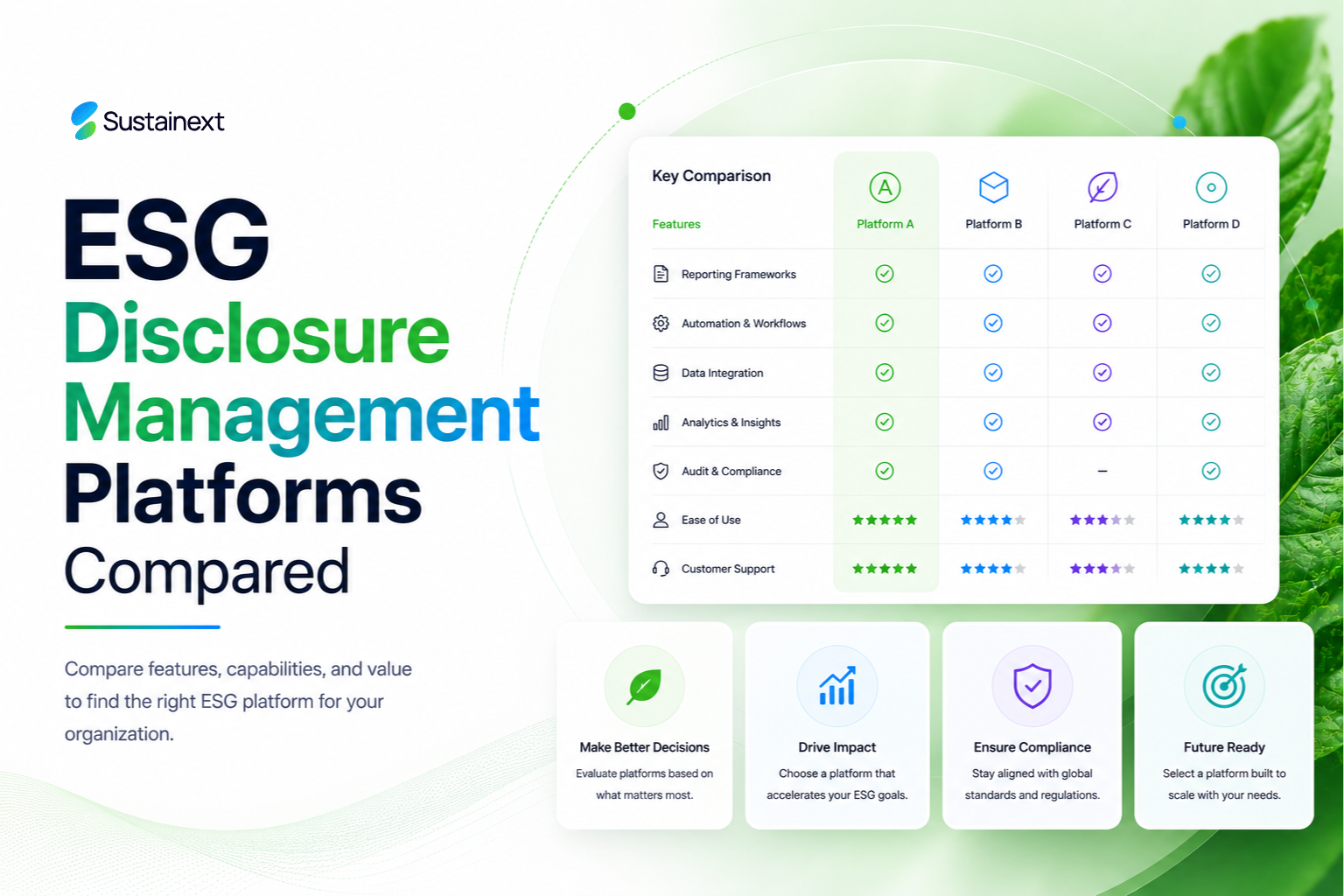
Step 5: Choose software that supports mapping, not just publishing
Good ESG software should let you:
- capture one metric once
- map one source to many frameworks
- assign owners and approvers
- preserve evidence and version history
- manage narrative and metric reuse
- support assurance readiness
That is a very different requirement from a simple disclosure authoring tool.
A practical framework mix for most companies
For many mid-size and enterprise reporting teams, the most realistic setup looks like this:
- GRI for broad impact-based sustainability storytelling
- ISSB for investor-focused disclosure structure
- ESRS where EU-regulated reporting applies
- CDP for environmental questionnaires and market requests
The smart move is not choosing one and ignoring the rest. It is deciding which one sets the primary reporting architecture and which ones become mapped outputs.
That same logic applies when reporting teams extend into adjacent ESG ecosystems such as eCOVADIS for supplier-facing sustainability assessments or GRESB for real asset and fund benchmarking.
What good ESG reporting looks like in 2026
By 2026, mature ESG reporting programs are moving away from standalone annual-report projects and toward continuous disclosure operations.
The strongest teams now aim for:
- one governed source of truth
- reusable disclosures across frameworks
- evidence-based workflows
- clear materiality logic
- cross-functional ownership
- assurance-ready controls
This is the real answer to the complexity of sustainability reporting frameworks. The frameworks are not the biggest problem. Fragmented data is.
Conclusion
Understanding ESG reporting frameworks does not require memorizing every acronym. It requires knowing what each system is designed to do and where they overlap.
- GRI helps explain impacts.
- ISSB helps explain financially relevant sustainability risks and opportunities.
- ESRS operationalizes regulated reporting with double materiality.
- CDP structures environmental disclosure for the market.
- Jurisdictional rules sit on top as mandatory overlays.
The companies that scale reporting efficiently will not build separate compliance machines for each framework. They will build one trusted data model and map it across multiple standards, questionnaires, and obligations.
That is how you reduce duplicated work, improve disclosure quality, and turn ESG reporting from a scramble into a system.
FAQs
What are ESG reporting frameworks?
ESG reporting frameworks are structured systems that help companies decide what sustainability information to disclose, how to organize it, and who it is for. Common examples include GRI, ISSB, ESRS, and CDP. They differ in purpose: some focus on impacts, some on investor relevance, and some on mandatory compliance. (globalreporting.org)
What is the difference between GRI and ISSB?
GRI focuses on an organization’s impacts on the economy, environment, and people, while ISSB focuses on sustainability-related risks and opportunities that affect enterprise value for investors. In short: GRI is broader stakeholder reporting; ISSB is investor-focused disclosure. (globalreporting.org)
How is ESRS different from other sustainability reporting frameworks?
ESRS is closely linked to the EU corporate sustainability reporting regime and applies a double materiality lens, meaning companies assess both financial effects on the business and impacts on people and the environment. That usually makes ESRS more process-heavy than purely voluntary reporting systems. (finance.ec.europa.eu)
Can one dataset support multiple ESG frameworks?
Yes. In many cases, one governed dataset can be mapped across GRI, ISSB, ESRS, CDP, customer questionnaires, and related programs such as eCOVADIS or GRESB. The key is consistent metric definitions, evidence trails, and framework mapping logic.
How do I choose the right ESG reporting framework?
Start with mandatory obligations, then identify your main audience, materiality requirements, and data maturity. Most companies do not choose just one framework. They choose a primary reporting architecture and map the same information across additional disclosure requirements.