If you are trying to understand an EcoVadis score for the first time, you are not alone. Many suppliers, procurement teams, and ESG leaders get confused by the difference between scores, medals, badges, percentiles, and eligibility rules. The confusion has only grown as EcoVadis has refined how recognition works over time.
This guide offers a plain-English explanation of EcoVadis score explained for 2026: what the score actually measures, how EcoVadis scoring works, what the latest medal thresholds mean, how badges differ from medals, and why two companies with similar scores can end up with different public recognition.
Whether you are preparing for your first assessment or trying to move from Bronze to Silver, this article will help you focus on what actually changes the result.
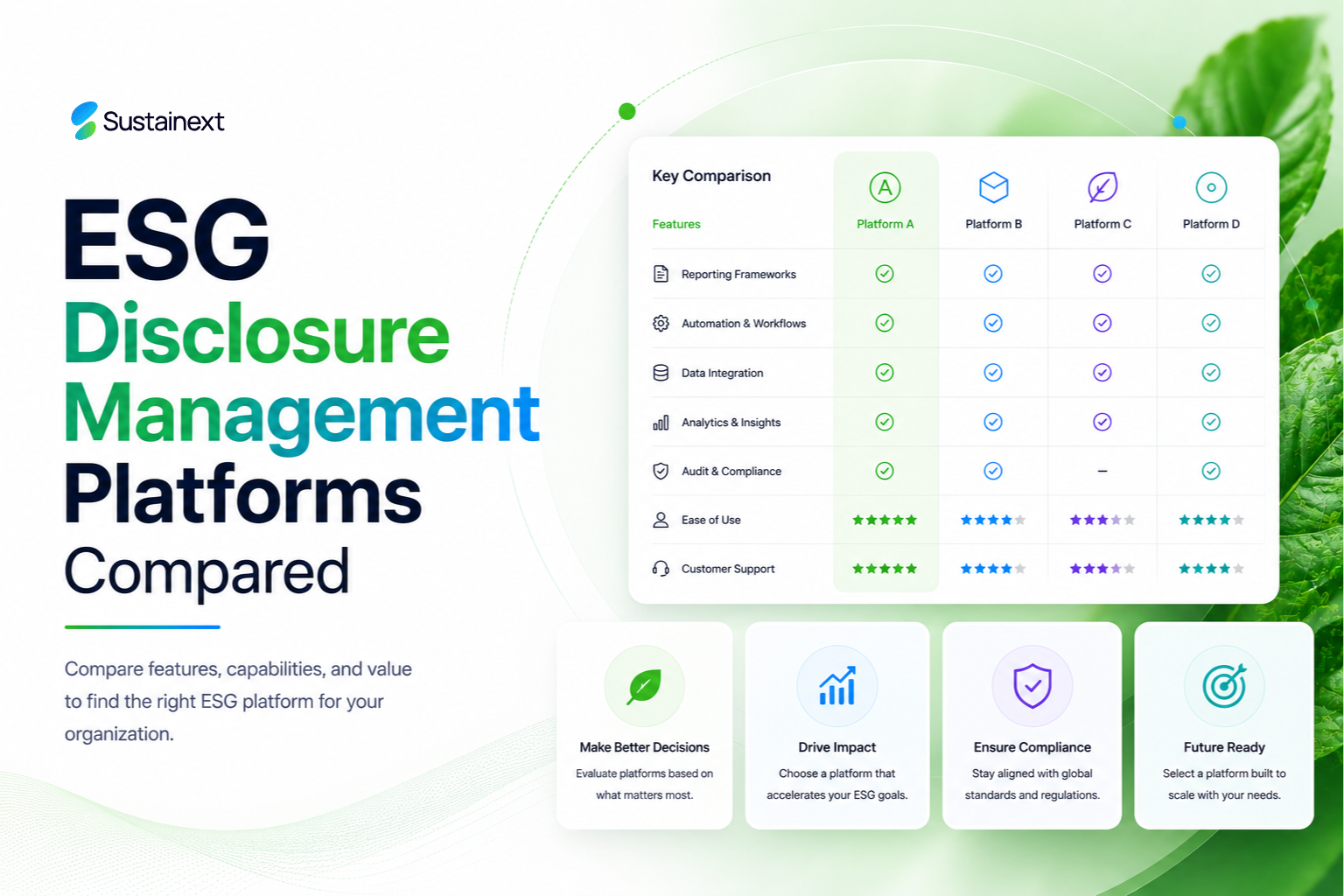
For a broader view of the rating ecosystem, Sustainext also covers the basics of EcoVadis and how companies compare ESG tools in its guide to ESG disclosure management platforms.
What an EcoVadis score actually measures
At its core, an EcoVadis score is a 0–100 assessment of the quality of a company’s sustainability management system at the time of review. It is not a carbon footprint label, not a product certification, and not a guarantee that one company is “more sustainable” in every sense than another. EcoVadis itself states that medals and badges recognize the strength of the management system evaluated through its methodology. (EcoVadis Medals and Badges)
That distinction matters.
A strong score generally reflects how well an organization can demonstrate that it has:
- formal policies
- concrete actions and implementation
- measurable results or reporting
- evidence that those practices are managed consistently
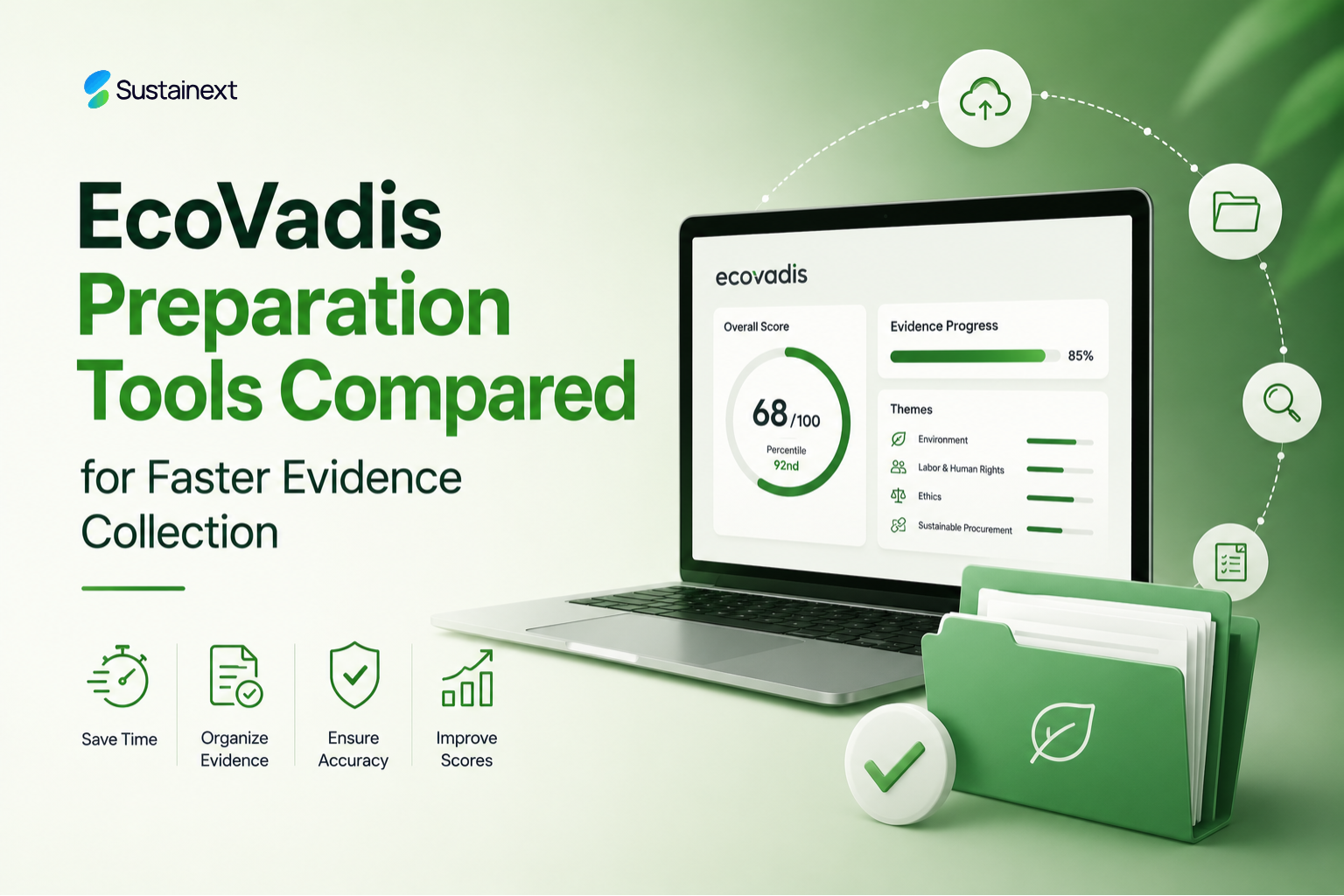
EcoVadis assesses companies across four themes: environment, labor & human rights, ethics, and sustainable procurement. It uses 21 sustainability criteria, selecting the ones most relevant to the company based on industry, size, and geography. (EcoVadis Help Center methodology)
So if you have ever wondered how EcoVadis scoring works, the short answer is this: EcoVadis is scoring the maturity and credibility of your sustainability management system, not just your intentions.
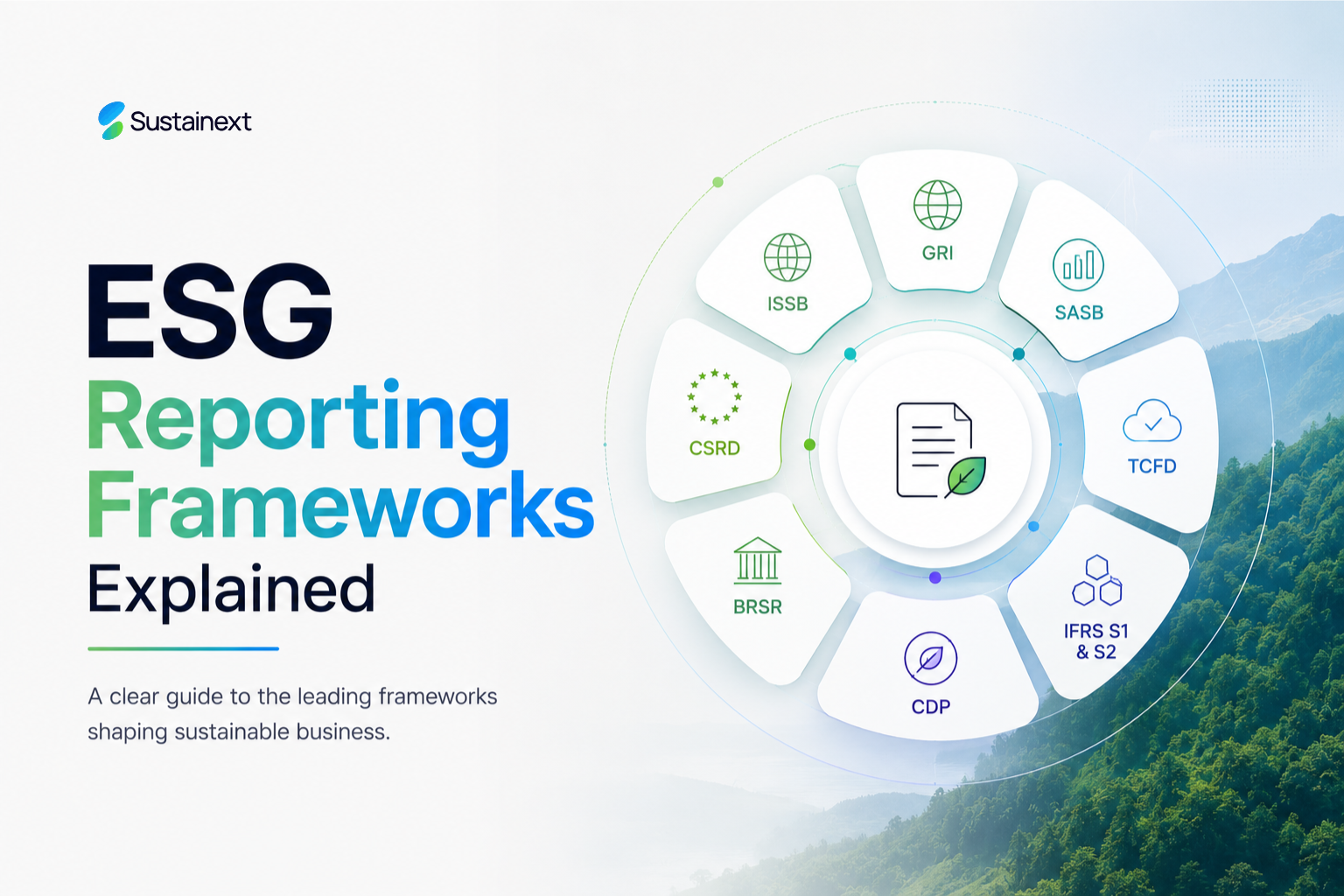
If your team is also working on adjacent ESG reporting requirements, Sustainext’s article on ESG reporting frameworks explained helps place EcoVadis in the wider reporting landscape.
How EcoVadis scoring works in practice
Most companies think the score is mainly about filling in a questionnaire. It is not. The questionnaire is only the starting point.
EcoVadis reviews evidence related to your management system and assigns scores across relevant sustainability themes. According to EcoVadis methodology materials, the assessment is built around policies, actions, and results, alongside external information sources including 360° Watch findings. (EcoVadis Scoring Principles; Methodology overview)
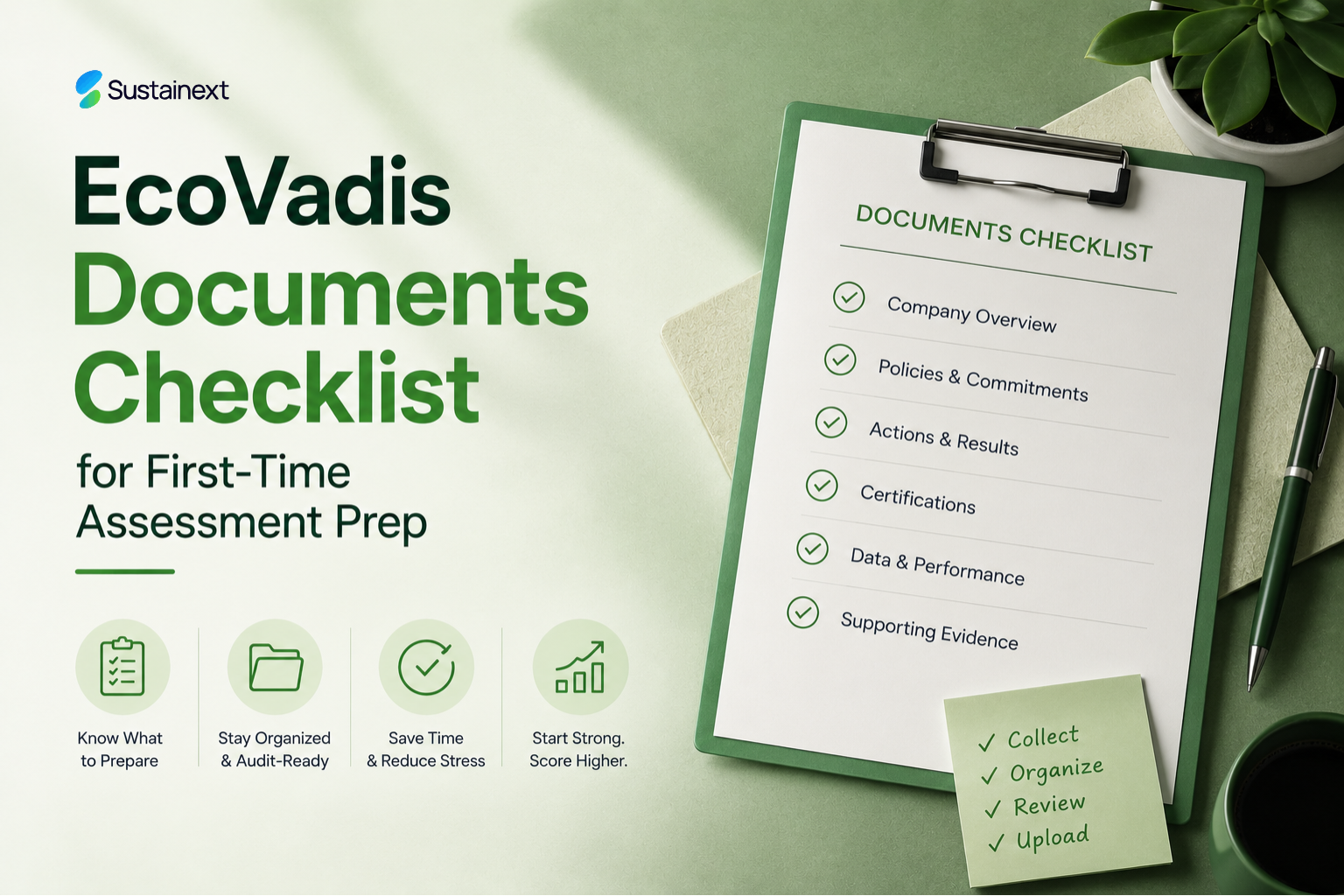
In practical terms, companies usually gain or lose points based on the quality of documentation such as:
- sustainability policies approved by leadership
- issue-specific procedures and governance structures
- training records
- audit programs
- certifications
- supplier codes and supplier engagement records
- KPIs and performance metrics
- corrective action plans
- public disclosures and reports
- proof of implementation at site or business-unit level
This is one reason first-time suppliers often underperform. They may be doing good work operationally, but they cannot prove it in the format EcoVadis expects.
For companies trying to structure this evidence better, Sustainext’s platform is built around workflow, data capture, and audit-ready sustainability processes rather than one-off spreadsheet effort.
The four themes behind your score
EcoVadis evaluates companies across four main themes:
- Environment
- Labor & Human Rights
- Ethics
- Sustainable Procurement
Not every theme is weighted the same way for every company. The relevant criteria depend on what is material for your business. A manufacturer with complex suppliers and environmental impacts will face a different emphasis than a professional services business with lower operational footprint.
That is why comparing raw scores across companies without context can be misleading. EcoVadis uses a materiality-based approach tailored to company profile. (EcoVadis methodology disclosure document)
This also explains why some companies are surprised by low scores in sustainable procurement. They may have internal ESG policies but weaker supplier due diligence, limited supply chain traceability, or little evidence of procurement controls.
If your organization is also measuring upstream emissions and product data, Sustainext’s guide to Product Carbon Footprint (PCF) can help connect procurement data with broader sustainability management.
EcoVadis medal thresholds 2026: what Bronze, Silver, Gold, and Platinum mean
One of the most searched topics is ecovadis medal thresholds 2026. Here is the most important thing to understand: medals are no longer just about score bands. They also depend on percentile ranking and eligibility criteria.
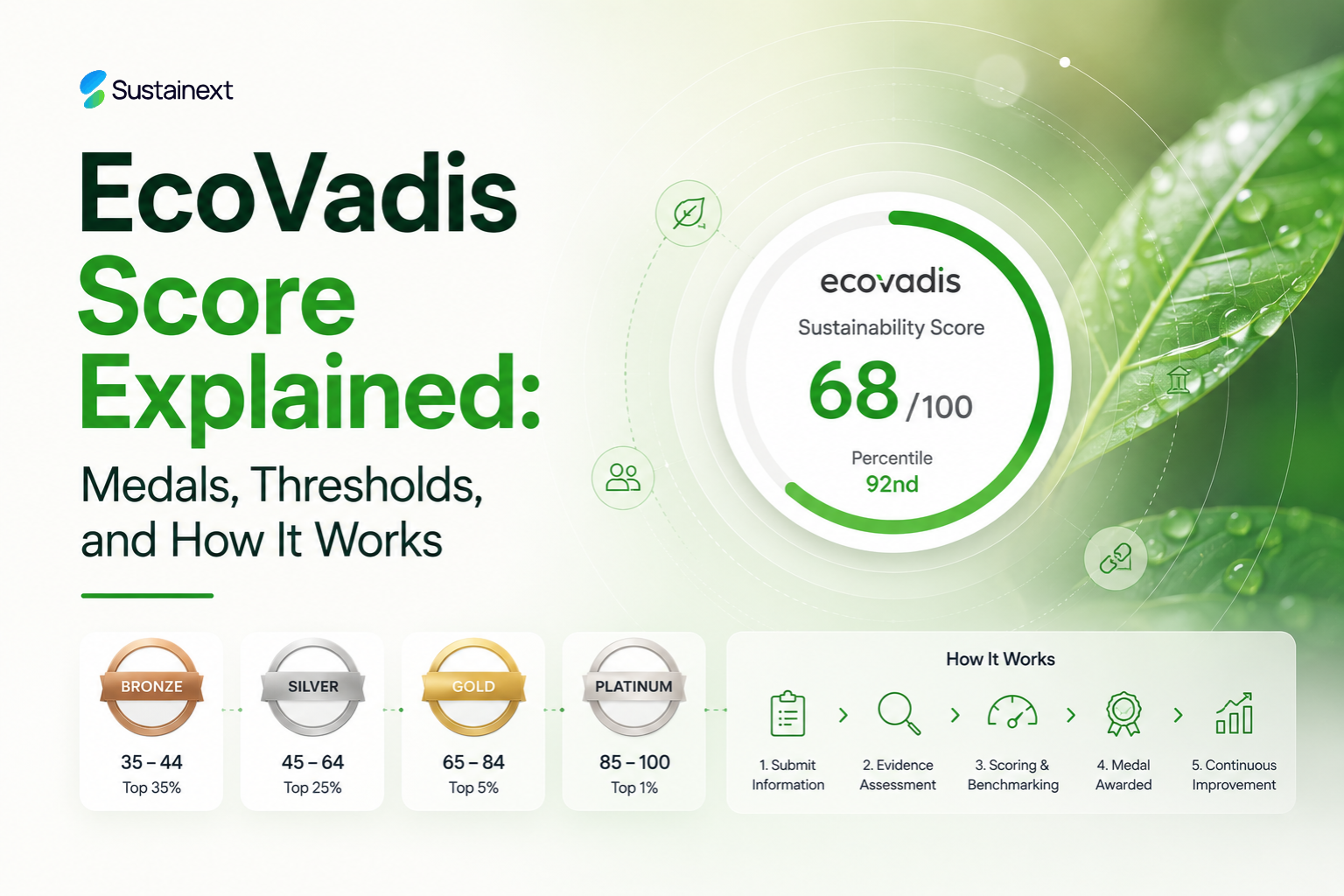
Based on current official EcoVadis guidance, medal recognition is tied to both score thresholds and percentile performance among rated companies over the previous 12 months. EcoVadis states the following public structure for medals: (Official medals and badges page; Help Center explainer)
- Platinum: top 1% and score of 81+
- Gold: top 5% and score of 73+
- Silver: top 15% and score of 66+
- Bronze: top 35% and score of 58+
So when people ask about ecovadis bronze silver gold platinum, the answer is not simply “58 is Bronze, 66 is Silver, 73 is Gold, 81 is Platinum.” Those scores are necessary, but not always sufficient on their own. Your percentile ranking and eligibility status also matter.
This is one of the biggest reasons companies get confused. A score can look strong in isolation, but if it does not satisfy the percentile condition or other eligibility checks, the final recognition may differ.
EcoVadis percentile ranking explained
The phrase ecovadis percentile ranking refers to how a company compares with the population of rated companies in the previous 12 months. EcoVadis has publicly explained that percentile rank is calculated at the time the scorecard is published and used to determine medal levels. (EcoVadis benchmark update blog)
This means two important things:
1. Your recognition is relative, not purely absolute
A score of 66 may still qualify for Silver if it meets the percentile and eligibility requirements. But percentile-based logic means medal recognition reflects your position among peers in the assessed population, not just a fixed static grid.
2. Threshold logic can evolve over time
As the assessed population improves, percentile-based cutoffs can tighten in practical terms. That is why outdated blog posts often mislead readers. They discuss legacy score cutoffs without addressing the relative ranking model now emphasized by EcoVadis.
In simple terms: improving your management system is necessary, but so is understanding that the benchmark population is moving too.
EcoVadis badges vs medals: what is the difference?
Another common source of confusion is ecovadis badges vs medals.
Medals are the more widely recognized distinctions: Platinum, Gold, Silver, and Bronze. Badges recognize specific levels of performance or improvement when a company does not qualify for a medal but still meets certain criteria.
According to the official EcoVadis medals and badges page, current badges include examples such as: (EcoVadis medals and badges)
- Committed Badge: score between 45–57
- Fast Mover Badge: score between 34–44 with a minimum 6-point improvement compared with the previous assessment in an 18-month period
Both medals and badges are also subject to additional eligibility rules beyond score and percentile thresholds. That matters because companies sometimes assume a badge is automatic once a score range is reached. It is not always automatic.
Just as importantly, EcoVadis clarifies that medals and badges do not represent a certification or product label. They apply only to the assessed entity and are generally valid for 12 months, in line with the scorecard validity period. (EcoVadis Help Center; How can I use my medal or badge?)
Why a company can have a decent score and still miss a medal
This is where the topic becomes practical.
A company may have a score that appears medal-worthy and still not receive one because of eligibility exclusions. EcoVadis publicly states that certain 360° Watch findings can make a company ineligible for medals regardless of total score. For example, the methodology disclosure document notes that a company can be ineligible if the 360° Watch indicator score is 0/100 for at least one theme or 25/100 for at least two themes. (EcoVadis methodology disclosure document)
This is a critical point for suppliers.
It means your total score is not the only thing procurement teams or customers should care about. Serious controversies, weak external signals, or unsupported claims can affect recognition outcomes even when your submitted documents look acceptable.
Where companies typically lose points
Companies rarely lose the most points because they have “no sustainability activity.” More often, they lose points in familiar and fixable ways:
1. Policies exist, but they are too generic
A one-page sustainability policy is rarely enough. EcoVadis expects topic-specific evidence linked to material issues.
2. Actions are claimed, but not documented
If you say supplier audits happen, show the audit program, sample findings, remediation tracking, and governance cadence.
3. Results are weak or not quantified
Companies often submit policies and training records but fail to present KPIs, targets, baseline data, trendlines, or outcomes.
4. Evidence is outdated
Old policies, expired certifications, and historical reports reduce confidence in current system maturity.
5. Documents do not match the questionnaire response
Misalignment between narrative answers and evidence is a common reason for lower credibility.
6. Sustainable procurement is underdeveloped
Many firms have internal ESG controls but limited supplier screening, code-of-conduct enforcement, or corrective action frameworks.
7. Ownership is fragmented
When HR, EHS, compliance, procurement, and operations all hold pieces of the evidence, submissions become inconsistent and incomplete.
This is exactly why companies benefit from centralizing compliance and reporting workflows. Sustainext’s home platform overview explains the value of combining consulting support with platform-led execution, especially for complex, cross-functional ESG programs.
What helps improve an EcoVadis score fastest
If your goal is practical improvement, focus less on “gaming” the score and more on strengthening the system behind it.
The highest-impact levers are usually:
- formalizing issue-specific policies
- assigning ownership and governance
- documenting implementation across functions
- building measurable KPIs and targets
- strengthening supplier due diligence
- collecting evidence continuously, not at submission time
- closing corrective actions visibly and on record
- aligning external disclosures with internal controls
For benchmarking software and operating models that support these workflows, Sustainext’s article on ESG reporting software: 10 best tools for 2026 is a useful next step.
Common misconceptions about EcoVadis scoring
Let’s clear up a few persistent myths.
Myth 1: EcoVadis is only about the questionnaire
No. The real score depends on the evidence and external review behind the submission.
Myth 2: A high sustainability claim equals a high score
No. EcoVadis rewards documented management systems, not marketing language.
Myth 3: Medals are permanent
No. Public recognition is generally tied to a scorecard validity period of 12 months. (Official medal usage guidance)
Myth 4: Same score always means same recognition
No. Percentile ranking and eligibility rules can change the outcome.
Myth 5: EcoVadis is the same as broad ESG reporting
Not exactly. It overlaps with ESG reporting, but it is primarily a supplier sustainability assessment framework. If you are comparing rating schemes like GRESB and broader disclosure programs, Sustainext’s GRESB guide and framework explainer provide helpful context.
A simple way to think about your result
If you want the shortest possible summary of how EcoVadis scoring works, think of it like this:
Score = how strong and well-documented your sustainability management system is
Medal = whether that score, your percentile rank, and your eligibility status qualify for public recognition
Badge = recognition for meaningful performance or improvement when medal criteria are not met
That framing helps avoid the most common mistakes.
Conclusion
Understanding EcoVadis gets easier once you separate score, percentile, medal, badge, and eligibility.
Your EcoVadis score is not just a number. It reflects the maturity, credibility, and evidence quality of your sustainability management system at a specific point in time. Medals like Bronze, Silver, Gold, and Platinum are based on more than score thresholds alone. Badge recognition follows a different logic. And hidden issues such as weak documentation, poor external signals, or lack of measurable results can prevent a company from achieving the recognition it expected.
For first-time suppliers, the biggest opportunity is usually not “answering better.” It is building a more defensible operating system behind the answers.
If your team wants to move from reactive submissions to structured readiness, explore Sustainext’s EcoVadis page or see how its platform-led approach supports evidence collection, ESG workflow management, and continuous improvement.
FAQs
What is a good EcoVadis score in 2026?
A “good” score depends on your goal. In practical terms, 58+ may qualify for Bronze, 66+ for Silver, 73+ for Gold, and 81+ for Platinum, but only if percentile ranking and eligibility criteria are also met. So a good score is one that supports your target recognition and customer expectations. (EcoVadis official medals page)
How does EcoVadis percentile ranking work?
EcoVadis compares your company with rated companies from the previous 12 months. Your percentile rank is calculated at scorecard publication and helps determine medal eligibility. It is a relative benchmark, not just a fixed score table. (EcoVadis benchmark explanation)
What is the difference between EcoVadis badges and medals?
Medals are Bronze, Silver, Gold, and Platinum. Badges recognize companies that show meaningful performance or improvement but do not meet medal criteria. Examples include the Committed Badge and Fast Mover Badge. (EcoVadis medals and badges)
Why did my company not receive a medal despite a decent score?
Possible reasons include percentile ranking, eligibility rules, or adverse 360° Watch findings. A company can be ineligible for a medal even with a respectable total score. (EcoVadis methodology disclosure)
What documents improve an EcoVadis score most?
The most useful evidence typically includes formal policies, governance records, training logs, KPI dashboards, audit reports, supplier due diligence records, certifications, and proof of corrective actions. The strongest submissions show policy, action, and measurable result together.